 |
| House Wren |
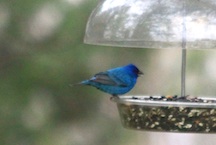 |
| Indigo Bunting |
Here are some of the birds we have seen over the last few days.
 |
| Gold Finch |
 |
| Hummingbird |
 |
| Oriole |
 |
| Purple Finch |
 |
| Rose Breasted Grossbeak |
 |
| Yellow Warbler |
|
| House Wren |
|
| Indigo Bunting |
|
| Gold Finch |
|
| Hummingbird |
|
| Oriole |
|
| Purple Finch |
|
| Rose Breasted Grossbeak |
|
| Yellow Warbler |
 This vulture is natures ultimate garbage collector with a bill that can rip open the toughest cow hide, yet with feet like a chicken instead of mighty talons like an eagle. A Turkey Vulture can eat carrion (dead and decaying animals) that are rotted and diseased and not get sick or die, as a matter of fact the birds droppings are disease free. The turkey vulture in fact plays an important role in protecting other animals from getting sick. Turkey Vultures love warm sunny days when the air currents are active and they can soar very high in a flight pattern called a kettle. Vultures are very common in Wisconsin and can be identified by the formation of their wings, when they soar and glide they hold their wings in a gentle "V" formation. Turkey Vultures are about the size of an eagle without the white head, as a matter of fact the Turkey Vulture has a "bald" red head and the Bald eagle has a "hairy" head of white feathers. I wonder why they don't call it the bald vulture? Probably because all vultures are bald...maybe.
 This bird has no song or call because it does not have a voice box (syrinx) so it hisses and grunts to make sounds; otherwise they are generally silent. Vultures have an instinct that makes them want to return to it's summer feeding grounds the exact same time every year regardless of the weather, which is around the vernal equinox (the first day of Spring). In 1994 bird scientist (who knew such thing existed) determined that the Turkey vulture was actually a member of the stork family. Did you also know that some of these same bird scientists estimate that vultures will consume 111 ponds of rotted, spoiled, diseased, dead things in a year? If the carrion is scarce a vulture will eat pumpkins, leaves,seeds and grass.


 |
| A Flicker in our yard. We have a lot of ants, and Flickers love ants. |
 |
| A Flicker on the prowl |
 |
| A suet cage from the store...my suet |
 |
| A plastic mesh bag from oranges |
 |
| A jumbo turkey bag tied up |
 |
| A homemade suet holder...thanks Aaliyah |
 |
| Blue Jay |
 |
| Downey Woodpecker |
 |
| Downey Woodpecker |
 |
| Female Cardinal...never saw the male all day |
 |
| Goldfinch |
 |
| Junco |
 |
| Piliated Woodpecker |
 |
| Pine Siskin...Christmas light in back...(not a ghost) |
 |
| Tufted Titmouse |
 |
| Turkeys...2 of about 20 |
 |
| White Breasted Nuthatch |
 |
| Red Squirrel |
 The joke goes like this.
 |
| I took photo in Missouri |
 |
| This was taken on our deck, here is a mom and her fledgling |


 Now this is one very popular bird; it is the mascot for many sports teams (when I was in grade school our basketball team was called, the Schofield School Cardinals) and the state bird for seven states. North Carolina, West Virginia, Ohio, Illinois, Indiana, Kentucky, and Virginia have named this bird their state bird; it is so colorful. Cardinals are shy birds, they are often among the first to the feeders in the morning and the last to the feeders at night. They don't seem to compete with other birds for time at the feeder, but are very territorial when it comes to breeding and nesting.
 I know that people usually talk about cute little song birds, and the majesty of hawks and eagles, or the sport of game birds but no one ever seems to talk about the really "ugly" birds. California Condors are an endangered species of bird, they are gaining in numbers however, and are doing well because of help that the have received from captive breeding. California Condors have a wingspan of over 9 feet, so they are able to spread their wings and sail on the wind currents and soar over canyons and wide open spaces in the southwest of our United States without having to flap their wings very much. A condor can weigh up to 20 pounds and would be almost 4 feet tall if he were perched on a rock ledge or tree.
 Condors are part of, and the largest of the Vulture family of birds and are scavengers. Like the turkey Vultures that we have in Wisconsin in the spring and summer, they often eat things that are already dead. California Condors can live up to 60 years, that is pretty old for a bird and represents a lot of dead things. The Condor’s diet consists of medium and large-sized dead mammals like cattle, sheep, deer, and horses in any state of decay. Condors may travel several hundred miles in search of food. Condors are almost entirely black and like our own Turkey Vulture have bald featherless heads. They often stick their heads into the dead bodies of animals...yuck. Their heads range in colors from pink and red to blue and orange.
 |
| A Turkey Vulture on Hwy KK |
 |
| Goldfinches in the G.W. Mead Wildlife Area |
 |
| From Cornell Lab of Ornithology |
 |
| Eastern Meadowlark(???) photo I took at Buena Vista, |

